REFLECTION: One of the roads we frequently travel during the early morning rush is under construction. At the best of times, it can be quite a wait for a break in the traffic large enough to make that right turn at the Stop sign and get up to speed. Now that construction has narrowed the road from two lanes to one, things have changed.
There is still just as much traffic as before. What’s different is that all those vehicles are now trying to thread the needle through a single lane, so it’s even more nonstop than before. But, no longer is the wait interminable.
You don’t wait at that Stop sign for long, until a driver on the main road slows to a crawl and motions you to pull into the space created. And, once one person makes that gesture of kindness, most who trail behind follow suit. What was previously a Stop and Hope intersection morphs into a Merge and Wave demonstration of civility.
In our world, there’s lots of attention paid to ‘civil disobedience’ – raucous demonstrators and riots in the streets. However, not much attention is paid to civil obeisance – those everyday simple gestures of deference and respect that turn our world into a friendlier place.
ACTION: The most amazing thing about the whole phenomenon is that it only takes one. (more…)
PAUSE – 11.39 – Extending Compassion
November 1, 2011
REFLECTION: There’s a first time for everything. It’s a trite but true saying that packs a lot of impact.
I was thinking about that idea this week as I prepared to deliver a session on appreciation and encouragement for a group of corporate trainers.
To an experienced presenter, another day in the seminar room might be experienced as ‘business as usual’. However, for some of the first time learners, being in a classroom may be far from their everyday experience. Although a change of pace and a chance to learn something new may be exciting for them, it may also feel risky. And if their past experiences in learning settings were not exactly supportive (like long division trauma at the Grade Five chalkboard), they may be worried about whether they will measure up, be embarrassed, or even be able to understand what’s going on.
Think back to a few of your own experiences along the way: starting grade one, first day of high school, beginning a brand new job. Although you may have been all smiles on the outside, chances are good there was a major case of nerves brewing on the inside.
It’s not just education that delivers the first time jitters. Healthcare: first time you undergo surgery. Finance: first time you sign your name for a major loan or a mortgage. Parenting: first time you realize this helpless creature is entirely dependent on you.
REFLECTION: Over the years, I’ve developed a habit that helps me focus on what matters most. Each week, I sit down for ten minutes late Sunday or early Monday, and build my list of priorities in four areas: Work, Home&Family, Community, and Personal. This is not an exhaustive collection of calls, errands, and follow-ups. I leave those bits and pieces to an electronic calendar. It is a specific list of projects and major/minor tasks that I hope to focus on and advance over the next seven days.
Sometimes a landslide of unexpected issues come up and hijack what I’d planned. In those instances, the list from one week to another looks nearly identical. Other times, like this Monday, when I reviewed last week’s Priority List, I was amazed at how many things I’d accomplished. And, I was delighted by how good that felt.
In that instant, I was reminded in a very personal and experiential way of the powerful impact of progress.
On this point, two Harvard researchers have recently confirmed what we instinctively hold to be true. It feels good to move things forward.
In their research, Amabile and Kramer discovered that when people consistently take steps forward – even small steps – on meaningful projects, they are more creative, productive, and engaged. This, in turn, has a positive influence on their work performance.
A & K refer to this phenomenon as the progress loop. It’s a cycle that has self-reinforcing benefits. Make progress on tasks, and you feel better about yourself. Feel better about yourself, and you’re more likely to make positive progress on tasks. And so it goes.
ACTION: What does this mean for our lives at work and at home? (more…)
PAUSE – 11.37 – Voila!
October 18, 2011
REFLECTION: Root vegetable soup, bison medallions, creme brulee, and a large serving of ‘Laurent’ on the side! That was the menu for a recent dinner in Montreal at a small restaurant made larger than life by the presence of the one man show that was Laurent.
Our server/chef was a tall, wiry character with an easy smile and a strong desire to please partnered with a clear love of food. Laurent moved back and forth through the restaurant orchestrating the experience for several small groups of diners. A smile of welcome here! An ‘I’ve not forgotten about you’ nod and tap to his forehead there. A hand resting lightly on a diner’s shoulder as he rounded the corners between the tables.
His eyeglasses flew repeatedly from their fold in his pocket to the end of his nose as needed. Warmth and energy emanated from the open kitchen – with the odd flambe thrown in for effect. The presentation of each dish at the tables was accompanied by a grand flourish of the arms along with a delighted, childlike clapping of the hands. The message? ‘Voila! Magic has just been performed before your very eyes.’
The food was good but the experience was delightful! How engaging to be in the company of someone so solidly in their element and so clearly in the zone!
We dined the next evening at a high end restaurant in Vermont where the food was superb, and the service was stellar. However, we both agreed our dinner was missing one key element – the joi de vivre of Laurent!
ACTION: This experience made me wonder what others notice when they see me in action at work and at home. You might ask yourself the same question. (more…)
PAUSE -11.36- Psych Safety – The New Workplace Imperative
October 11, 2011
REFLECTION: I’ve just returned from the 15th Annual Health Work and Wellness Conference in Toronto. Over the years, I’ve attended five of these conferences; and it’s been interesting to watch the shift in focus over time. Initially the conversation was mostly about physical wellness – helping employees become more physically fit through increased exercise, healthier eating, and addressing risk factors for diabetes and heart disease.
This year, much of the conference focused on initiatives in the area of psychological safety. This moves us firmly into the arenas of mental and emotional health. These areas are harder to measure (and tougher to talk about), but they are every bit as important to productive workplaces as an emphasis on healthy bodies.
What we’re talking about here is creating a workplace culture that is respectful and civil – one in which people are responsible not just for their contributions to profits or corporate goals, but equally accountable for the impact of their everyday behaviour on others. Metaphorical hard hats and flak vests are rarely required. Leaders don’t carelessly overload employees, burning them out in the pursuit of corporate success. Berating, browbeating and bullying are not tolerated.
ACTION: Researcher, Martin Shain, recommends organizations concentrate on three approaches to create more psychologically safe workplaces:
1. Set reasonable and clear demands. Don’t blindly delegate work and raise expectations without attending to the impact of those new directions.
2. Make it safe for employees to speak up. Develop skills throughout the organization in raising concerns, asking questions, and listening with care.
3. Be vigilant about challenging even minor acts of incivility. Create a culture of courage – one in which people stand up for themselves and defend each other in the face of disrespectful comments or actions.
How does your workplace measure up on each of these elements? How might you and your colleagues strengthen an area where your culture falls short of the ideal?
QUOTE OF THE WEEK: “Health is a state of complete physical, mental and social well-being, and not merely the absence of disease or infirmity.” – World Health Organization, 1948
Or you might prefer a more succinct version from Author Unknown: “Just because you’re not sick doesn’t mean you’re healthy.”
RESOURCE OF THE WEEK: Looking for more specific tactics on setting the tone for a mentally healthy culture? Check out this section of the Great West Life Resource Centre for Mental Health. You’ll find suggestions for building: credibility, respect, fairness, pride and camaraderie in the workplace.
READERS WRITE: In response to a recent e-zine message on ‘Energy Issues‘ Pause reader JM writes: I work with people on low-income who lead highly emotionally stressful lives. Frequently they have developed a lifelong habit of being consumed by their barriers, and it keeps them in a chronically hopeless, lethargic state. I have often encouraged them to consider getting involved in a volunteer activity, a new hobby, or even a new habit like walking the kids to school or walking to the grocery store, just to take a break from their ‘lives’. I know that once they get involved in something else, they will begin to see hope and find the courage to move beyond their current situation. But many cannot even see that this is possible. Your quote for this week reminds me that I should keep encouraging them to think about it. Thanks!! (“The more you lose yourself in something bigger than yourself, the more energy you will have.” – Norman Vincent Peale )
PAUSE – 11.35 – Why Bother? Surveys Say…
October 4, 2011
REFLECTION: The evidence is in, and it’s decisive.
* When employees take part in corporate sponsored fitness programming absenteeism and turnover are reduced.
* Every dollar invested in wellness initiatives creates significant returns through reduced staff turnover, gains in productivity gains and a drop in medical claims.
* Informal breaks cut down on mental strain and increase feelings of well-being. Micro breaks maintain or increase productivity.
Integrating renewing, re-energizing breaks into busy workdays creates major returns on multiple fronts – not just for employee wellness and engagement but also for organizational productivity and profitability.
The business case has been well established over the last decade and continues to grow in strength. I’m attending the National Health Work and Wellness Conference this week in Toronto, and will be sharing more of the most recent findings with you in future messages.
ACTION: So what does this mean for you and your organization? (more…)
Vermont Venturing
September 29, 2011
I’ve just spent the last few days of September enjoying the start of the fall season here in Vermont and New Hampshire.
While husband, Dave, took an Artisan Bread Baking at Home class at King Arthur Flour in Norwich, VT, I rambled the highways and byways with camera and sketchbook at hand.
This is a fabulous time of year to be in New England.
The fall colors are spectacular, and driving down any road is a treat – pure and simple.
I’ve posted a couple of images here for your enjoyment.
You’ll find a more complete set of pics and paintings on my Facebook page. See the Vermont Venturing album.
Around Montreal
September 28, 2011
Montreal – always a unique experience. Here are a few bits from our recent 24 hour visit.
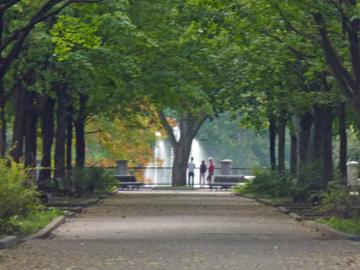
We stayed in Plateau Mont Royal area at Auberge de la Fontaine near Parc La Fontaine on Rue Rachel. The park and its green spaces are great for a stroll – and the whole area is uber bike friendly. Pictured here is the fountain itself – at the end of a broad walking boulevard.
Also, pictured here – a little wildlife – in the form of a free range three year old intent on communing with a neighborhood squirrel.
Speaking of communing, I enjoyed my chat with the Whisperers. Les Chuchoteuses is the official name for this fabulous bronze sculpture by Rose-Aimee Belanger on Rue Saint Paul in Vieux Montreal.
If you’re down in the area, I highly recommend dropping info for lunch at Olive Et Gourmando – a sweet little bistro. I’ve eaten there several times over the years and never been disappointed.
Stumbled across this pint-size sculpture in a residential sidestreet. I call her InnukChick. Quite the wig! And if I’m not mistaken, that is a bonafide chicken foot on the end of her walking stick!
And, finally, a sketch I did from the balcony of our room – looking down on the balcony next door. While I did this sketch, 5 squirrels made forays up and down the staircase. Nervy little fellas!
Always something interesting to see and do in one of Canada’s great cities.
Halifax Adventures
September 28, 2011
I spent a couple of days travelling to and working in Halifax last week. What a beautiful city with so much to explore.
I was greeted by a fabulous sunset on the day of my arrival. Have to say those Atlantic sunsets can easily rival the beauty we see on the prairies.
The next day, with a few daytime hours to spare before getting to work, I decided to adventure to an area that I had not visited before. Hydrostone Market is a block long village that was one of the first to be rebuilt after the Halifax explosion of 1917. It was originally designed with concrete bricks and tree lined avenues to recreate an English style suburban garden feel.
It was recently restored in 1993 and now you’ll find a vibrant community of shops and restaurants. I strolled a few of the bystreets – where an ivy covered veranda caught my attention. Set up my stool and my sketchbook and captured it in the morning sun.
Enjoyed an almond croissant and coffee at Julien’s Bakery. It was fun watching the locals come and go for their morning visits and errands.
Shopped the village strip, and then settled down at Epicurious Morsels for a late lunch of smoked salmon, seared scallops, on a bed of spinach with a bacon vinagrette. Gave me time to catch another sketch of the vibrant street scene.
Hydrostone is a bit off the beaten path – but a great place to spend a few hours in the autumn leaves and sunshine. Thank you Halifax.
PAUSE -11.34- Energy Issues?
September 20, 2011
REFLECTION: How is your energy these days? Feeling bright and chipper, ready to take on the world? Dragging your backside out of bed in the morning, wondering how you’ll make it through another day? Or, maybe somewhere in between?
If you’ve explored the area of energy management, you’re probably familiar with the four categories of energy that can be drained or recharged: physical, mental, emotional and spiritual. The thing is that it’s not always clear what causes an energy shortfall, and what needs attention.
For example, you can be emotionally drained by relationship issues, and experience that as physical exhaustion. You can experience fuzzy thinking and a lack of concentration, and assume it’s because you have too many things on your mind. That fuzziness may, in fact, flow from the fact that you’re feeling totally disconnected from purpose and direction. You’ve sprung a leak in your spiritual gas tank!
Crossed wires can explain why our efforts to recharge may prove futile. (more…)


 REFLECTION: One of the roads we frequently travel during the early morning rush is under construction. At the best of times, it can be quite a wait for a break in the traffic large enough to make that right turn at the Stop sign and get up to speed. Now that construction has narrowed the road from two lanes to one, things have changed.